

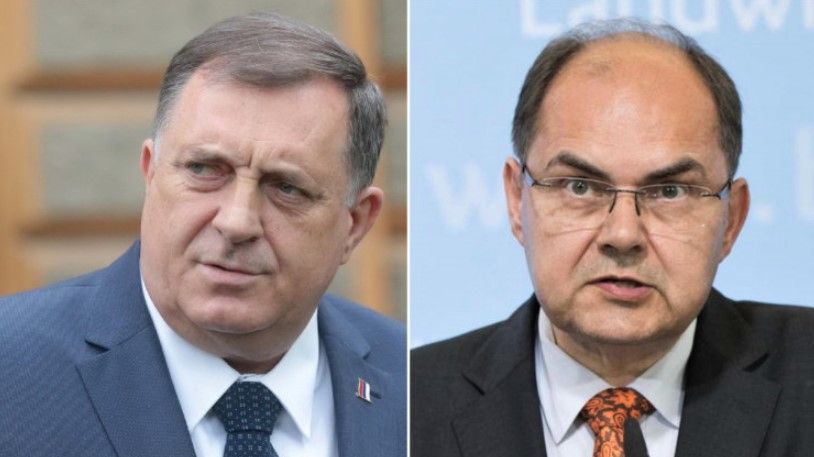

Outgoing High Representative in Bosnia and Herzegovina Christian Schmidt, in an interview with Deutsche Welle, may have unwittingly confirmed what has been speculated about for months in political and diplomatic circles - that his departure is not just a personnel change at the helm of the OHR, but part of a much broader shift in American and Western policy toward Bosnia and Herzegovina and the region.
A serious message
And at the center of that shift is Milorad Dodik. Schmidt spoke very openly about his own departure for the first time in the interview, acknowledging that he did not make the decision overnight and that he no longer feels the full international consensus necessary to continue his mandate.
- "I have to be able to rely on the fact that I have consensus within the international community," Schmidt said.
In diplomatic language, that is a very serious message.
The High Representative never drew his power solely from the Bonn Powers or formal mandate, but primarily from the political unity of key Western powers standing behind him, first and foremost US support. If that unity no longer exists, then the position of the High Representative itself becomes significantly weaker.
That is precisely why Schmidt's interview seems like an indirect admission that the international approach toward BiH is shifting tectonically - and that the US is no longer prepared to "fix the state" through the High Representative as has been the case so far.
The most indicative part of the conversation was when Schmidt spoke directly about Dodik. According to his words, the SNSD president engaged lobbying firms to achieve three goals: enabling the secession of Republika Srpska, annulling court verdicts and sanctions against him, and ultimately his departure.
- "He invested a lot of money in this," Schmidt said.
Such a formulation sounds almost like a political indictment, but stated this way and as an admission that Dodik, to a certain extent, succeeded in influencing a change in the relationship within the international community, especially regarding US relations. For if international policy had remained identical to a few years ago, it would be hard to imagine Schmidt today talking about "loss of consensus," "different approaches," and the need to "open the way for others."
Because of this, the question is increasingly opening up whether his departure is part of a much broader political arrangement that includes the new American administration and a redefinition of relations with Republika Srpska. This theory is further reinforced by the new strategic document of the American administration on the Western Balkans, submitted to the US Congress, in which Washington essentially announces the end of the era of "nation-building" and international tutelage over the Balkans.
In that document, it is clearly seen that American priorities today are: regional stability, security issues, energy projects, countering Russian and Chinese influence, and protecting American economic interests. Much less focus is on long-term political transformation of Balkan societies or endless international governance of Bosnia and Herzegovina.
In other words, Washington today views the Balkans much more pragmatically than twenty years ago. And it is precisely in that context that the approach to Dodik is also changing.
This does not mean that the US has abandoned the territorial integrity of BiH. On the contrary, the American document very clearly confirms support for Bosnia and Herzegovina's sovereignty and warns against destabilizing moves. But it is evident that part of the American administration now does not see Dodik as a problem to be eliminated, but as a bearer of concrete power with whom "the job needs to be finished."
A more pragmatic model
Instead of a policy of constant sanctions, political reckonings, and dramatic crises, the new approach could be based on a more pragmatic model - lowering tensions, controlling conflict, and attempting to stabilize relations, even with certain concessions. In such a framework, Schmidt becomes a symbol of the old policy of strong interventionism, the High Representative as the central arbiter, and the attempt to discipline domestic politicians through international pressure.